

You finish a song, someone leans toward the stage, and the question arrives:
“Do you know…?”
Sometimes you do. Sometimes it is exactly what the room needs. Other times, you don’t know the song, it needs musicians you haven’t brought, or it would take the set somewhere you don’t want to go.
Taking requests is part musical judgment and part hospitality. You want people to feel heard while giving them an honest answer about what you can deliver.
A few clear expectations—and a few comfortable phrases—make that easier.
A quick guide to the awkward moments
| Situation | Something you can say |
|---|---|
| You don’t know the song | “I don’t have that one ready, but I can play something else by them.” |
| You know it, but it doesn’t fit right now | “I know that one. Let me see where it fits.” |
| Someone interrupts during a song | “Catch me at the end of this one.” |
| You’ve received more requests than you can play | “We’ve got room for a couple more tonight, so I’m closing requests after these.” |
| A tip comes with an expectation you can’t meet | “Thank you for the support. I can’t promise that song tonight.” |
Use wording that sounds like you. The useful part is being warm, clear, and careful about what you promise.
You don’t have to know every song
Knowing your own repertoire is part of being prepared. Knowing every song someone might name is an impossible standard.
When a request is outside your repertoire, a short answer usually works better than a long apology:
“I don’t play that one, but I’ve got another by the same artist.”
If you don’t have an obvious substitute, ask what they like about it:
“Is it that artist you’re after, or something with that kind of feel?”
That can turn an unavailable song into a useful clue. They may want something familiar to sing along with, a slower moment, or a song from a particular era.
Offer an alternative you can perform confidently. You can also simply say:
“Good suggestion. I haven’t got it ready for tonight.”
You haven’t committed yourself to learning it at the next break or playing it at their next visit.
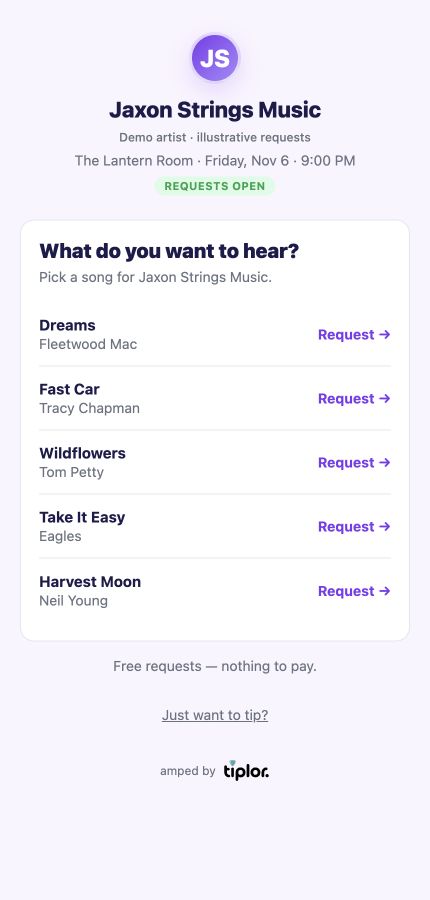
Give people a list you’re comfortable playing.
A defined song list gives fans a useful starting point. You can welcome suggestions while making your repertoire clear.
Tiplor’s fan interface, rendered with fictional demo artist Jaxon Strings Music and an illustrative song list. Free requests shown.
Enlarge the fan screenshot (opens in a new tab)Separate “I heard you” from “I’ll play it”
A casual “sure” can sound like a promise, even when you mean “I’ll think about it.”
If you’re still deciding, say so:
“I’ve got your request. Let me see whether we can work it in.”
If you’re committing to it, make that clear too:
“Yes—we’ll play that in the next set.”
This distinction matters when several people are asking for songs. It gives fans an honest expectation and saves you from repeated visits asking when their song is coming.
Requests also don’t have to run in arrival order. You may need to think about the singer’s range, a tuning change, the players on stage, or how the next few songs fit together.
You can explain that without giving the audience your entire set-planning process:
“We’re fitting requests around the set, so they might come up in a different order.”
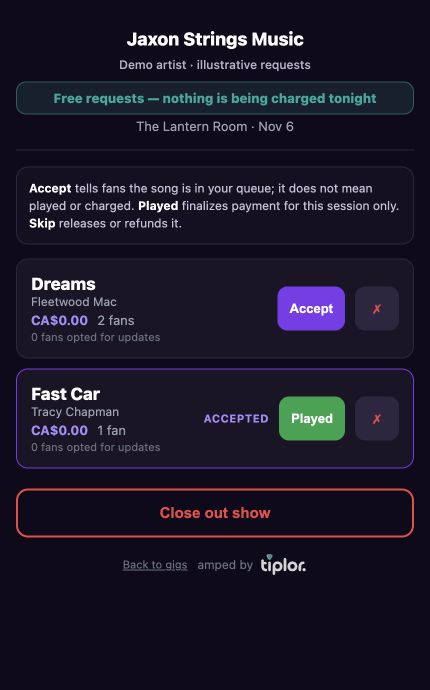
Receiving a request, accepting it and playing it are separate decisions.
In Tiplor’s Stage view, Accept puts a song in your queue. Played records that you performed it. Skip lets you decline it.
Current product interface rendered with fictional demo artist Jaxon Strings Music and illustrative requests. Free requests shown; no real fan requests or payments.
Enlarge the Stage screenshot (opens in a new tab)Keep a good request from becoming an interruption
Someone approaching during a song may be enthusiastic rather than deliberately inconsiderate. A friendly gesture toward the end of the song can be enough.
Between songs, give the room a clear way to ask:
“We’re taking a few requests tonight. Come and see us between songs.”
If you use a written list or a phone-based request page, explain where it is and when you’ll check it. Choose something that works with how you perform.
If reading a screen means losing contact with the room, check requests between songs or sets. If a bandmate is handling them, agree beforehand on how suggestions reach the person calling the set.
The process should help you stay present with the audience.
Money makes clear expectations more important
Some performers welcome requests with no payment attached. Others offer paid requests. A fan may also put money in the tip jar and then ask for a song.
Those situations can create different expectations. Make your arrangement clear before someone pays.
For paid requests, explain:
- Which songs people can choose.
- Whether you still need to approve the request.
- Whether you can promise a place in tonight’s set.
- What happens to the payment if the song isn’t played.
For a paid-request arrangement that follows this rule, you could say:
“We’re taking paid requests from this list tonight. Only pay for requests that get played.”
A sign or request page can explain the basics, but your answer still matters when someone asks directly.
If you already know you cannot play a song, say so before accepting payment specifically for it.
If someone tips first and then names something you don’t know, acknowledge the support and clarify the request:
“Thank you—I really appreciate that. I don’t know that song well enough to play it tonight. Is there another one you’d like?”
Avoid suggesting that a bigger payment will solve a problem you cannot actually solve.
Close requests while you still have time to deliver
A request arriving two songs before closing is different from one arriving at the start of the night.
Once you know how much room remains, tell people:
“We’ve got time for two more requests before we finish.”
Or:
“We’re closing requests now so we can get through the ones we’ve already agreed to.”
If a request you committed to will no longer fit, speak to the person where practical. A direct explanation is kinder than leaving them waiting through the final chord.
For a paid request, follow the payment arrangement you explained beforehand.
Advance requests need their own boundaries
Inviting requests before a show can help you learn what people are hoping to hear. It can also give you time to prepare something special.
Be clear about what the invitation means:
“Send us a suggestion for Friday. We’ll choose a few that fit the set.”
That creates a different expectation from:
“Choose a song and we’ll learn it for you.”
If learning a new song is something you offer, agree on the song, deadline, arrangement, and any charge separately. A suggestion box should not accidentally become a promise to rehearse every submission.
When someone keeps pushing
You can be friendly without reopening the decision every time.
“Thanks for the suggestion. We won’t be playing that one tonight.”
You don’t need to keep supplying new reasons. Thank them, move back to the performance, and involve venue staff if their behaviour begins disrupting the show.
The rest of the audience is there for a good night too.
Let requests teach you something
After the show, note the songs people asked for—especially the ones that came up repeatedly.
Over several gigs, you may start seeing useful patterns: an artist your audience loves, a gap in your repertoire, or a song that works particularly well in one room.
Those observations can help you choose what to learn next. Your judgment still shapes the set.
A good request gives you information about the people in front of you. What you do with it is part of the performance.
Want a clearer way to collect requests?
Tiplor lets artists offer optional free or paid Song Requests while keeping control over what they accept and play.
Our Song Requests guide explains setup and how the request and payment flow works.
Whether requests arrive through a phone, a piece of paper, or a conversation beside the stage, the same approach helps: welcome the suggestion, give an honest answer, and promise only what you can deliver.