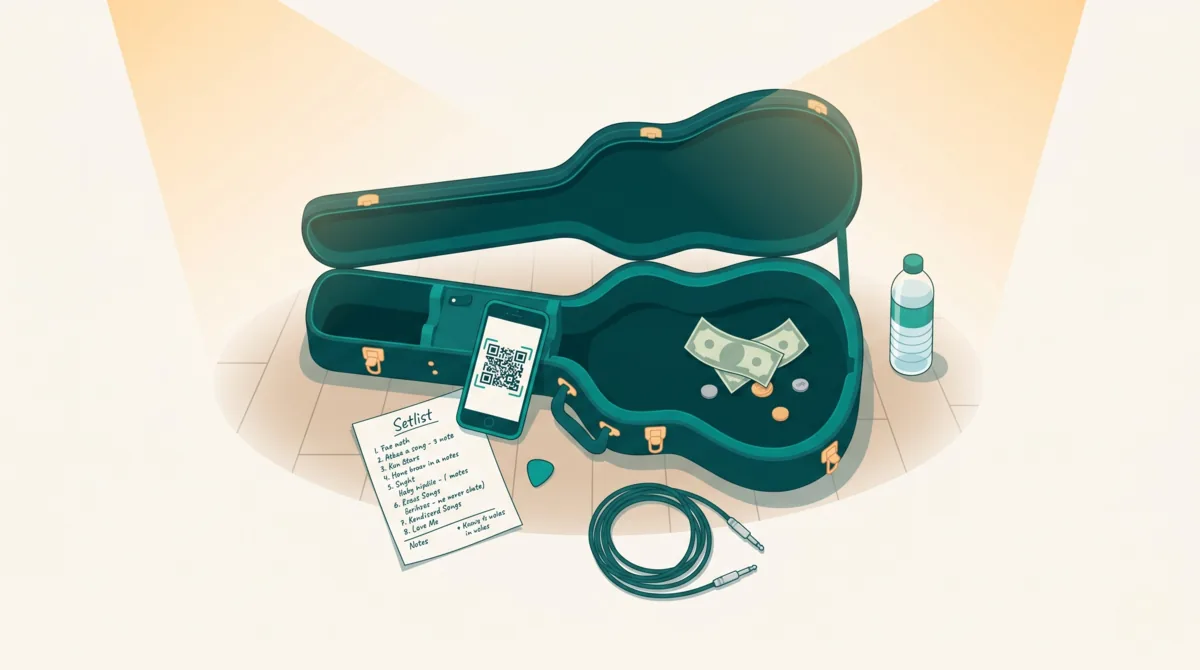



Your set was great. The room was warm. At the end of the night you looked down at your tip jar — bills inside, maybe more than usual — and felt the small satisfaction of a gig that paid. The jar worked.
Probably not as well as you think.
A Full Tip Jar Isn't What It Looks Like
The thing a tip jar measures is "people who had cash and chose to give it to you." The thing it doesn't measure — and can't — is everyone else. The fan who would have tipped but reached for their wallet, found a single debit card, and put it back. The fan who pulled out a phone instead of a billfold because that's what they do everywhere now. The friend who came up to compliment you after the set and didn't have a single dollar on them.
Those tips didn't happen. Not because the fans didn't want to give them. Because the only collection method on the table couldn't accept what they were carrying.
If your tip jar is full at the end of the night, the right read isn't "tipping is healthy." It's "I caught the cash carriers." Which is a smaller and smaller share of any room.
The 1-in-5 Problem
Here's the data, from the most authoritative source on Canadian payment behavior — the Bank of Canada's Methods of Payment Survey:
20%
Share of Canadian point-of-sale transactions paid in cash, 2024
(Bank of Canada Methods of Payment Survey)
Roughly 1 in 5. That's how many of the people in front of you at a typical Canadian gig are paying for things in cash. The other 80% are paying with debit cards, credit cards, mobile wallets, or other digital methods.
The 2024 figure has been roughly stable since the pandemic — cash use settled at about one-fifth of in-person transactions and has hovered there since. But step back further and the long-term trend is unmistakable: cash has lost ground every decade for the last 30 years. Some of those fans switched to tap-to-pay. Some switched to digital wallets. Some never carry cash at all. The line is not coming back.
Now apply that to your gig. If 50 people are in the room, the cash math says about 10 of them are walking in with bills they could put in your jar. The other 40 are not — not because they don't like you, not because they're cheap, just because cash isn't what they carry.
Even if the 10 cash carriers tip generously, you're still capturing somewhere around 20% of the potential tipping audience.
It's Not Just Canada
The same trend is playing out across every major English-speaking market. Here's the cash share of in-person transactions in the four countries where most live performers tour:
The US sits at 16% of in-person transactions in 2024, down from 25% the year before, per the Federal Reserve's 2024 Diary of Consumer Payment Choice. The UK has gone the furthest — cash fell from 48% of all transactions in 2014 to 23% in 2019 to just 9% in 2024 (UK Finance, UK Payment Markets 2025). Australia's 2025 figure ticked slightly upward — the first uptick in over two decades, per the RBA's 2025 Consumer Payments Survey — but even with that bump, 85% of Australian fans aren't carrying cash to your gig.
The picture is more nuanced in continental Europe. The Eurozone average is 52% cash at point of sale, per the ECB's 2024 SPACE study, but the country-to-country variation is enormous: cash share is below 30% in Finland and the Netherlands but above 60% in Slovenia, Malta, Austria, and Italy. If you play in those higher-cash markets, your physical tip jar is still catching a meaningful share of your audience. But everywhere else on this list, the underlying problem is the same — the majority of fans walking into your gig do not have cash on them.
This Isn't Your Tip Jar's Fault
The first thing to be clear about: the physical tip jar still works. For the people who can use it, it's perfect. They see it, they put bills in it, you take it home at the end of the night. The transaction is fast, frictionless, and emotionally satisfying for both sides. There's a reason musicians have used some version of this for as long as there have been musicians.
The jar isn't broken. The jar is doing exactly what it's supposed to do.
What's changed is what's in fans' pockets. The jar is a brilliant collection method for cash. It's an impossible collection method for cards, phones, watches, and wallets. The problem isn't the tool — it's that the tool can only address part of the audience.
This matters because the obvious overcorrection is "if cash is dying, the jar is obsolete." That's wrong. The jar isn't obsolete; it's just incomplete. Killing it would lose the cash tippers. The right move is to keep it and add a second collection method that catches the people the jar can't.
The Second Jar
Imagine if, alongside your physical tip jar, you put a second jar that magically accepted phones and cards. Fans walking up could see two collection methods — the cash jar for people with cash, the digital jar for everyone else. They'd self-sort: cash people would use the cash jar, phone people would use the digital one. No friction, no awkwardness, no behavior shift required from either group.
That's what a QR code does. A printed QR card propped next to your tip jar is functionally a second jar. Fans without cash who would otherwise leave nothing instead pull out their phone, scan, and tip.
Crucially: this doesn't take anything away from your cash tipping. The fans who had cash before still have cash. They still use the jar. The QR code just adds a path for the 80% of fans who don't have cash to participate at all.
The Math at a Typical Gig
Let's run rough numbers on a 50-person bar gig. Don't take these as universal — your audience, venue, and tipping culture will shift them — but the structure of the calculation matters.
The cash side (what you're getting today):
- 50 fans in the room
- ~20% have cash on them, so ~10 cash-capable fans
- If 5 of those 10 tip, at $5 average = $25 in the jar (a "good" cash night)
The digital side (what a QR code would catch):
- The other 40 fans don't have cash but do have a phone with Apple Pay or Google Pay set up
- Conservative tipping rate: assume only 1 in 4 of them would tip if it took 10 seconds and required no app — that's ~10 fans
- At $5 average = $50 in digital tips on the same gig
Total: $25 cash + $50 digital = $75. That's 3× the cash-only revenue from the same gig with the same crowd. The cash didn't shrink — you still got the $25. The QR code added what was previously invisible.
You can play with the assumptions. If the digital tipping rate is half what we assumed (1 in 8 instead of 1 in 4), it's still $25 cash + $25 digital = double the cash-only number. If your average tip is bigger because someone hits the $20 button, the gap is even larger. The point isn't the precise number — it's that the math always favors having both jars instead of one.
What This Looks Like in Practice
Here's the part that makes this an actually-easy decision: nothing about your gig flow has to change. You're not being asked to learn new technology, switch platforms, or do anything different on stage.
- Keep your tip jar where it always was. On the merch table, on the corner of the stage, in your guitar case, wherever it lives.
- Sign up for a free digital tip jar (Tiplor takes about 5 minutes; no credit card needed). You'll get a unique QR code printed on a card.
- Prop the QR card next to your physical jar. A small sign that says "Or tip with your phone" works. Or just the QR by itself — fans recognize the pattern.
- That's it. Don't change anything about how you perform. Don't shoutout the QR if you don't want to. Don't change your set. The fans who have cash will keep using the jar. The fans who don't will see the QR, scan, and tip.
If you want to lean into it, a single mid-set line ("If you're enjoying the show, the tip jar takes cash and the QR code on the table takes everything else") is plenty. If you'd rather not interrupt the music, that's fine too — visible placement is enough.
Frequently Asked Questions
What percentage of Canadian point-of-sale transactions are still paid in cash?
About 20% in 2024, per the Bank of Canada's Methods of Payment Survey. The remaining 80% of in-person transactions are paid by card, mobile wallet, or other digital methods that a physical tip jar can't capture.
Does this apply outside Canada?
Yes, across every major English-speaking market. In 2024, cash made up 16% of US in-person transactions (Federal Reserve) and just 9% of UK transactions (UK Finance) — the lowest of the four. Australia sat at around 15% of payments by number in the RBA's 2025 survey — a small uptick from 2022 but still well below historical levels. Continental Europe is more complicated: the Eurozone average is 52% cash at point of sale per the ECB's 2024 SPACE study, but it varies wildly — Finland and the Netherlands are below 30%, while Slovenia, Malta, Austria, and Italy still sit above 60%.
Should musicians stop using physical tip jars?
No. The physical tip jar still works perfectly well for fans who carry cash — and roughly 1 in 5 Canadians still do. The problem isn't the jar; it's that the jar can only catch the small subset of fans with bills in their pocket. The right move isn't to replace the jar — it's to add a second jar (a QR code on a card) that catches the other 4 in 5 fans who don't carry cash.
Will fans get confused if there's both a physical jar and a QR code?
No. Fans self-sort. People who pulled out their wallet drop bills in the jar; people who pulled out their phone scan the QR. Most fans only ever see one option as available to them based on what they're carrying. The two methods don't compete; they cover different audiences.
Do I need to change anything about how I perform or interact with fans?
No. Keep your physical tip jar where it always was. Prop a QR code card next to it. The QR catches the fans the jar misses, automatically — no shoutouts required, no change to your set, no behavior shift on stage.
Will I get fewer cash tips because the QR code is there?
No — there's no evidence the presence of a digital tip option reduces cash tips. Fans who have cash in their pocket use it; fans who don't use the QR. If anything, the visible QR signals that tipping is normal and expected at your show, which can lift overall tipping behavior across both methods.
How much extra revenue could I realistically expect?
It depends on your audience and venue, but here's the rough math: if a typical gig produces $25 in cash tips from the ~20% of fans who carry cash, the same crowd's other 80% — if even a quarter of them tip via QR — would add another $50 to the same night. Without a digital option, that revenue is invisible because it never had a chance to land. Tiplor shows you exactly how many fans tipped digitally, so you can measure the additional revenue.
The argument here isn't that the physical tip jar is bad. It's that the physical tip jar, alone, only addresses 1 in 5 of your fans now — and that share keeps shrinking. Adding a QR code doesn't ask you to change a single thing about what you're already doing. It just catches the tips you've been quietly leaving on the table this whole time. The cash carriers still tip in cash. The other four-fifths of the room finally get a way to participate.
Your tip jar still works. Tiplor catches what it can't.