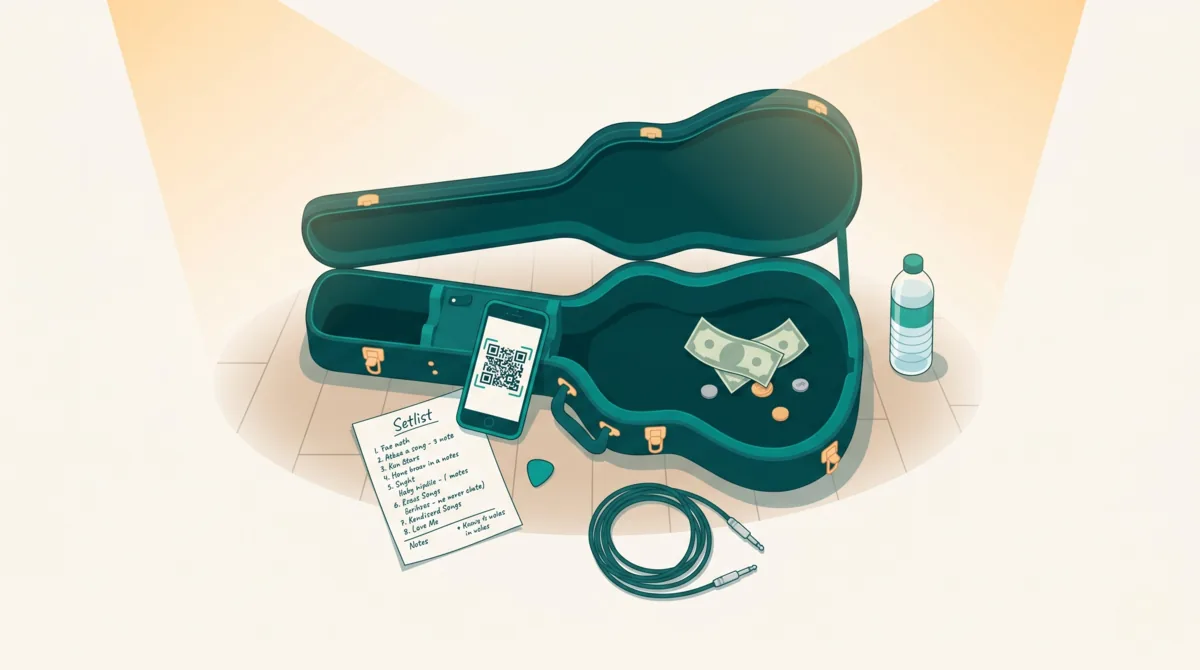



If you run a bar with live music, you already know the math: the door cover doesn't always cover the band, the bartender is busy, and most of the room is paying with a card. The physical tip jar at the front of the stage is doing what it can — but the part of the audience that wants to support the performer and literally has no cash in their pocket is walking out without leaving anything. That's not a customer-loyalty problem. That's a format problem, and it's the cheapest one to fix.
TL;DR — How a bar sets up tipping for live music
Add a digital tipping layer alongside the physical jar. The minimum-viable setup: agree on a split with the artist, give each booking a QR code that goes to a tipping page, display it on the tables and at the bar, brief the bartender and the band, and review the data after every night. A platform built for this — like Tiplor — handles the payouts and splits automatically so nobody at the venue runs the money through a personal account.
The Revenue Layer You're Missing
Live music nights are an investment. You're paying the booking fee, you're staffing for a crowd you hope will show up, and you're betting on the room. Tipping is where some of that bet pays off — for the artist, and increasingly for the venue when there's a split. But the way most bars run tipping today wasn't designed for an audience that pays with a phone.
The opportunity isn't to replace the tip jar that's already working. Cash tippers exist; they're worth keeping. The opportunity is to capture the rest of the room — the diners who paid the bill with a card and have nothing in their wallet, the people at the back table who'd love to throw something but won't walk up to the stage, the guest who left their cash for the bartender already. Done right, tipping becomes the kind of found money that turns a marginal music night into one that books itself.
What Most Bars Get Wrong
Three patterns we see at venues that haven't yet figured tipping out:
The stage-only tip jar. Works for the cash carriers, misses the rest of the room. If the only way to tip the band is to walk up to the front and drop bills in a jar, half your audience won't do it. Some are shy. Some are with a date. Most simply don't have cash.
The bartender's personal Venmo QR. Often someone — the bartender, the manager, the booker — has a personal account and a QR code printed on a card. It's fast, but it's a mess. There's no split logic, no receipt for the performer, no record for the venue, and the money sits in someone's personal app until they remember to move it. The first dispute or tax question makes it clear why this is a bad idea.
The hand-signal mid-set. The performer waves at the crowd, "We accept tips!" The audience guesses where to put them. The energy in the room drops for ten seconds while everyone figures out the logistics. The band loses its momentum. Nobody actually tips. Everyone moves on.
None of these are wrong in spirit. They're each trying to solve a real thing. They just don't fit the audience that walks into your bar today.
The Three Things a Working System Needs
Strip everything else away, and a tipping setup that actually works at a bar has three properties:
- Zero friction for the fan. No app to download. No account to create. They scan, they tap, they pay. Anything more than that, and the moment is gone.
- Visible from anywhere in the room. Not just the stage. The diners at the back, the people at the bar, the table tucked in the corner — they all need to see how to tip without having to ask.
- Trackable and splittable on the venue side. You should know what the band earned, what the venue earned (if there's a split), and what each night produced. No personal accounts. No spreadsheets. No "I think it was around $200 last Friday."
Every step below is in service of those three things.
Step-by-Step Setup
Step 1 — Decide the split
Before any tools, decide who gets what. The common patterns:
- 100% to the artist. The simplest and most common, especially for one-off bookings. The venue covers its costs through the door, the bar, and the room. The artist keeps every dollar of tips.
- Revenue share with the venue. More common for residencies, house bands, and weekly bookings where the venue is contributing meaningfully to the act's visibility and audience. A typical split is something like 80/20 or 90/10 in the artist's favor, but the right number is whatever both parties agree to in advance.
- Pooled across the night. Useful for charity nights, fundraisers, and multi-artist bills where the booking is the cause and the cash gets distributed afterward.
Whatever you choose, document the split with the artist in writing before the gig. The wrong place to negotiate a split is at 1am when the band is loading out.
Step 2 — Pick the right tool
Three options, in increasing order of how well they actually work:
- Physical jar only. Cheap, familiar, works for the cash carriers. Keep this — but don't pretend it's catching the whole room.
- A personal Venmo or Cash App QR. Works in the immediate term, breaks down the moment there's a split, a tax question, or a payout dispute. Not built for the venue use case.
- A dedicated platform. A platform like Tiplor is built specifically for this — the artist has their own profile, the venue has its own dashboard, the split is automatic, the payouts are clean, and nobody runs the money through a personal account. The bartender doesn't need to touch the system at all.
The dedicated-platform option is the one we'd recommend, and not just because we make one. It's the only option that produces clean per-night data, which is what you'll actually use to decide which artists to book again.
Step 3 — Display the QR everywhere it should be
Placement is the single biggest determinant of whether anyone scans. Put the QR code:
- On every table. A simple table-tent card with the band's name and the QR code, refreshed when the act changes. This is the single highest-yield placement because it puts the option in the diner's eye line while they're already on their phone paying the bill.
- At the bar. A small printed card at the bartender's station. Patrons standing to order see it without anyone having to mention it.
- On the artist's setup. A sticker on the mic stand, a card on the instrument case, a small sign next to the amp. Fans up close get a second nudge.
Print it big enough to scan in a dim venue — at least four inches per side for tabletop placement, larger for stage signage. High contrast, black on white, no clever fonts in front of the code itself.
Step 4 — Brief the bartender and the band
The bartender should know the QR exists and be able to point to it if a patron asks "how do I tip the band?" That's the entire bartender ask. They don't need to sell it; they just need to not be surprised by the question.
The band should mention it once per set, naturally. Something like "If you're enjoying the music tonight, the QR code on your table goes straight to us — no cash needed." One mention, no more. Selling it harder makes the room feel like a sales floor, which kills the thing you booked the band to create.
Step 5 — Track and use the data
After the first few nights, you'll start to see patterns. Which artists drive the most tipping. What time of night the curve peaks. Whether the QR-on-tables placement is converting better than the bar placement. This is the data that turns booking from "what's the artist's Instagram following" into "how does this act actually do at our room."
A good platform gives you this on the venue dashboard without anyone exporting spreadsheets. Use it. The first time you turn down a poorly-fitting booking because the numbers tell you it won't tip well, the system has paid for itself.
Time check
Steps 1-3 take an evening of prep. Step 4 is a five-minute conversation. Step 5 is ongoing. Total setup for the first night: well under an hour.
Common Mistakes to Avoid
QR only on the stage. The most common mistake. Half the room doesn't look at the stage closely enough to spot it, and the people at the back tables won't walk forward to scan. Tables and bar matter more.
Asking too aggressively. Some performers, especially newer ones, push the tip jar hard between every song. The room feels it. Don't let a band you booked turn the night into a fundraiser pitch — set the expectation up front that one mention per set is the move.
Making fans guess where their tip goes. One venue QR can still preserve attribution: let the fan choose the live performer first, then offer a clearly labelled staff or venue-support option below it. Keep those destinations distinct in the flow and reporting—rather than forcing one combined tip—so the venue, performer, and staff fund each stay clear.
Ignoring the data. The whole reason for moving past a cash jar is that you get visibility into who's tipping, what kind of nights perform, and which artists fit your room. If nobody on staff looks at the dashboard, you've spent the setup cost and skipped the payoff.
What About Song Requests?
Song Requests are now available on Tiplor for live performers—but the artist is the one who sets them up and decides when they are open.
For a band, solo performer, or other live artist using Tiplor, the same QR code can open a Song Requests page alongside tipping. Fans can choose from the artist's available repertoire, add support to a request already underway, or ask for something else when the artist allows it. The artist sees requests on their Stage screen and decides what fits: Accept adds it to their queue; Skip releases it. A paid request is only charged when the artist marks it Played.
That distinction matters for venues. Song Requests should support the performer's set—not turn the bar staff into music programmers. The cleanest role for a venue is the same one it has for tipping: make the artist's QR visible, let fans know it exists, and leave the musical call to the person on stage.
Artists can also keep requests free and use them as a living set list. It is a useful way to see what the room wants without changing the economics of the night.
Separate product, separate status
Artist Song Requests is live as an opt-in feature. Tiplor's broader venue/DJ/Jukebox product, Play it Next, is still in development and is not generally available for venue or DJ operation.
Read the artist guide to Song Requests →
Frequently Asked Questions
Is it legal for a bar to keep a portion of musician tips?
It depends on the jurisdiction and the agreement with the performer. In most regions, the venue and artist agree on a split in advance — sometimes 100% to the artist, sometimes a share to the venue covering operational costs. The key is that the split is disclosed and documented. A digital tipping platform makes splits explicit and automatic, so there's no awkward end-of-night cash count.
Should tipping the band be separate from tipping the bartender?
Yes—keep them as separate destinations and reporting categories, because fans are supporting different people. That does not require two QR codes: a venue QR can list the live performer first and a clearly labelled staff or venue-support option below it. The fan chooses where the tip goes, while attribution and reconciliation stay clear.
What are the tax implications of accepting tips at a venue?
Tips collected on behalf of performers are typically not the venue's income — they pass through to the artist. If the venue takes a documented share, that share is venue revenue. A good digital platform produces transaction-level reporting that makes year-end bookkeeping cleaner than counting cash. Talk to your accountant about how your specific arrangement should be classified.
What if my live music night isn't very busy yet?
Tipping setup pays off proportionally to attendance, but the setup cost is essentially zero. Having the system live from night one means you build the muscle and the data, so when a regular crowd does show up, you're not scrambling to set it up mid-quarter. The early nights also teach you which artists drive which kinds of tipping behavior — that's useful information for the bookings that follow.
Do fans actually use QR-code tipping at a bar?
Yes, and the share of fans paying digitally is climbing every year. In most North American venues, well under half the room is carrying cash on a given night. A visible QR code converts the part of the room that wants to tip but literally can't with what's in their pockets. The artists who run digital tip jars consistently report that it doesn't cannibalize the cash jar — it stacks on top.
Live music at a bar is one of the few experiences that still hits the way it always has. The audience is there, the energy is there, and the people who want to support what they're hearing are there too. Tipping done well doesn't change any of that. It just removes the friction between the moment of appreciation and the act of paying.